
What to see in Toulouse? What to visit in Toulouse ?
Today, I’m taking you to visit Toulouse, one of my favorite cities in France. Nicely nicknamed “the pink city” because of the color of its roofs and brick facades, it’s kind of my favorite city… Family roots and a year of studying in the Occitan capital allowed me to discover its charm and secrets… I hope I can convince you to visit Toulouse too!
First, I suggest a stroll to visit the five must-see places that are really worth a visit. This will be an opportunity for those who don’t know the city yet to discover it and for those who do to revisit it with some little-known anecdotes. Shall we go?
WHAT TO SEE AND DO IN TOULOUSE ? PRACTICAL TIPS
How to get to Toulouse?
Toulouse is 1 hour from Paris by plane and 4 hours by TGV.
Many cities are accessible by plane at low cost thanks to EasyJet (Lille, Lyon, Nantes, Nice). The train journey is a little longer, as the city is not very well served.
Access by car is possible, except in the city center, which is mostly pedestrianized. If you want a car to visit Toulouse and its surroundings, you can visit Discoverscars.com to compare prices.
Compare car rentals to find the best price!
Where to stay to visit Toulouse?
Here are several accommodation suggestions, ranked according to your budget.
3 places I recommend to visit Toulouse

HÔTEL LES CAPITOULS
- City center
- Beautiful & cosy
- From 120€

LE GRAND BALCON
- On the place du Capitole
- Modern 4 star hotel
- From 140€

MAISON TOULOUSAINE & JARDIN
- Up to 4 people
- Close to the subway
- From 130€
How to get around in Toulouse?
The city center is very easy to explore on foot, with most attractions concentrated around the Place du Capitole.
Using a bike can also be a good idea when venturing a little further from the center. Bike rides are quite pleasant, but you may have to get off your bike in pedestrian streets.
Otherwise, the Toulouse subway is a safe bet, with two automatic lines criss-crossing the city.
How many days do you need to visit Toulouse?
Toulouse is well worth at least a weekend to fully enjoy its charms.
If you only have time for a quick day trip, stick to the first 5 steps of the itinerary I suggest here.
What to bring back from Toulouse ?
The city center is full of lovely shops where you’ll easily find something to treat yourself to. Toulouse violets are a must. They come in candies, chocolates, soaps, gift baskets, and more. Le Paradis Gourmand offers all kinds of delicious confections and specialties in a retro setting. You’re sure to find something to treat yourself to in the tin boxes and glass jars that fill the shelves. – 45 rue des Tourneurs (Esquirol metro station)
Perhaps less well known, Toulouse pastel has been a real institution for several centuries. Nicknamed the blue gold of Toulouse, it is extracted from the leaves of a plant grown in the Toulouse region. Today, it is mainly used for the dermatological properties of its oil. The Terre de Pastel shop sells small gifts, beauty products, and household linen in pastel blue. A very pretty place to visit if you’re interested in pastels – Place d’Assézat (Esquirol metro station).
VISIT TOULOUSE : 1. THE PLACE DU CAPITOLE
Our first stop to visit Toulouse is in the heart of the city, at Place du Capitole, the symbol of Toulouse. The former “Place Royale,” completed in 1851, is now home to the Capitole, which serves as both city hall and theater. Its façade is truly magnificent, combining the two predominant colors of Toulouse: orange brick and regional pastel blue. As you get closer, you’ll notice lots of details, as it’s covered with statues and coats of arms carved into its wrought-iron balconies.
In the middle of the cobblestones of the Place du Capitole is a giant Occitan cross, symbol of the region’s history. The twelve balls at its ends originally represented the 12 apostles, but if you look closely, you will see that they have since been replaced by… the 12 signs of the zodiac!
All around the square, majestic brick buildings surround the Capitole. On the west side, take a look under the arcades to discover some beautiful paintings on the ceiling.


Everyone stops at this square, which is symbolic of the Pink City, but few people venture inside the Capitole. And yet it is one of the most beautiful places in Toulouse! The Cour Henri IV, through which you enter, is a jewel of Toulouse architecture with its pretty arcades.
At the end of the courtyard on the left, a majestic staircase takes you up to the rooms on the first floor. It’s a real palace, with its parquet floors, wood paneling, and murals. The ceremonial hall, called the “Salle des Illustres,” is somewhat reminiscent of the splendor of Versailles with its 60 meters in length. Tall marble columns support a magnificent painted ceiling depicting the history of Toulouse.
It would be a shame not to visit this legendary Toulouse building, which now houses the town hall and the opera house. And good news for Toulouse lovers: the Salle des Illustres is currently used as a wedding venue!
Free admission 

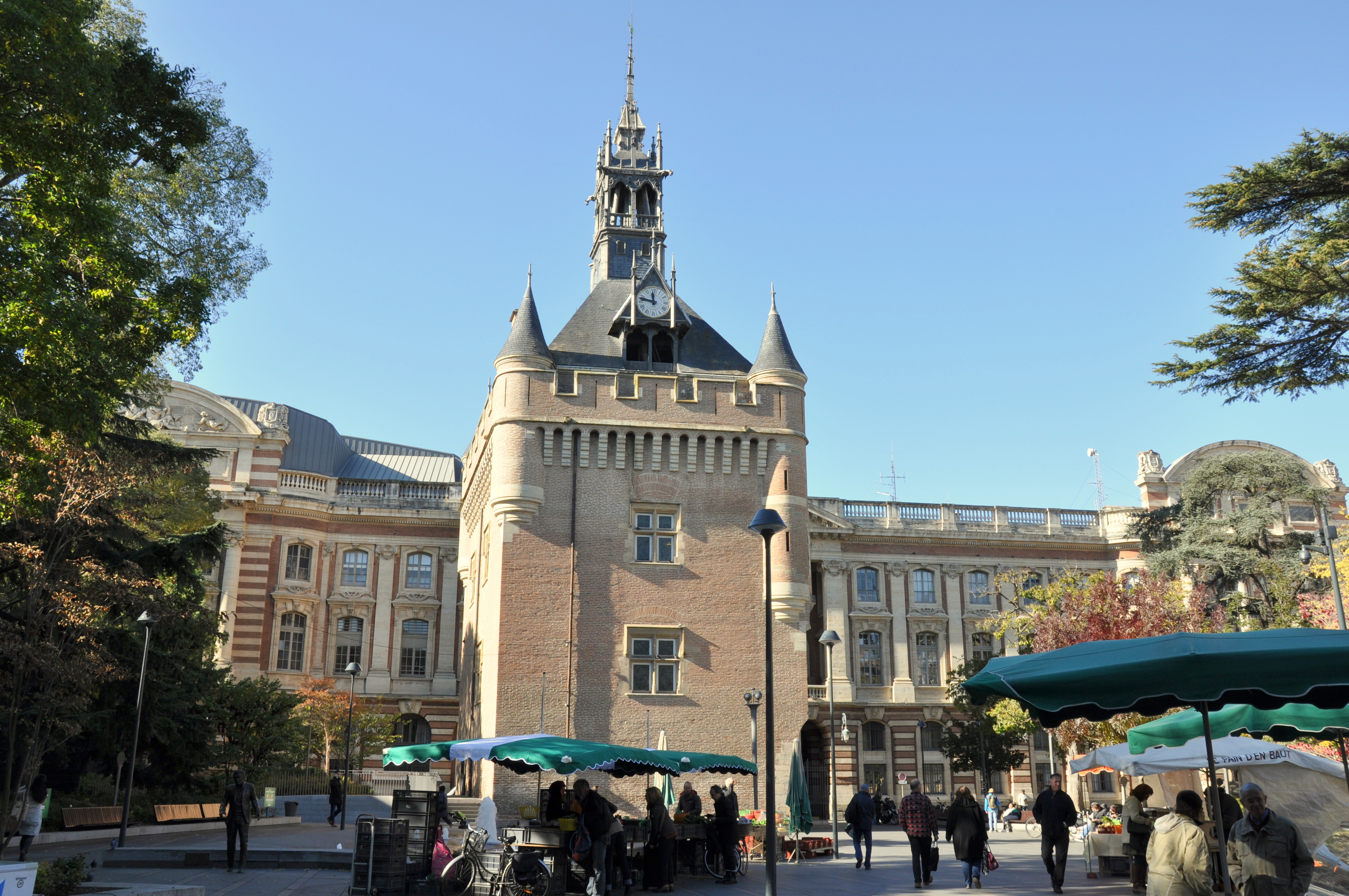
On the other side of the Capitole theater, the 12th-century keep is also worth a visit. It also houses the tourist office, if you need any further information.
It is also possible to visit the interior of the Capitole, and I highly recommend doing so as the rooms and inner courtyard are beautiful. See you in the next article on Toulouse to find out more about the treasures of the Capitole!
VISIT TOULOUSE : 2. LES JACOBINS
From Place du Capitole, take Rue Gambetta or Rue Pargaminières to reach Les Jacobins, a five-minute walk away. This is a former convent consisting of a superb church and a cloister. The interior space and tall colonnades make the church majestic, and you can also admire the beautiful stained glass windows. On sunny days, I recommend visiting the church in the middle of the morning, as the light passing through the stained glass windows casts red shadows on the opposite walls, creating a truly magical spectacle!


The Jacobins complex is known for its magnificent “palm tree,” a 28-meter-high column topped by twenty-two ribs that spread out across the ceiling. A few years ago, this palm tree is said to have inspired the painter Dali in his painting “Santiago el Grande” after a friend from Toulouse showed him a photo of the interior of the Jacobins. However, the painter apparently never acknowledged having included this detail in his work, which apparently upset his friend…
You can also visit the magnificent cloister next to the church. It’s a little haven of peace in the heart of Toulouse! (There is an entrance fee).
Practical information –Jacobins: Capitole metro station – Cloister: €4 (reduced rate: €2)

VISIT TOULOUSE : 3. THE GARONNE RIVER BANKS
A few minutes from the Jacobins, you will arrive at the Place de la Daurade, following Rue Jean Suau. This charming square is located on the banks of Toulouse’s main artery, the Garonne River. The quays are very pleasant in the summer evenings, and the people of Toulouse love to meet there for a drink. The Daurade district was already very lively in the 18th century as it was the city’s commercial port, with the Garonne River linking the Mediterranean Sea and the Atlantic Ocean.
As you walk down to the quays, you will notice two doors hidden in the wall below the square. During the summer, the snack bar Les Pêcheurs de sable takes over the premises, but in the past it was the old morgue! Bodies recovered from the river nearby were stored there awaiting identification… If the history of the place doesn’t appeal to you, go for a drink on the terrace of the Café des Artistes instead. It is open all year round, and you can enjoy the sunshine and a beautiful view.

From Place de la Daurade, you will see the beautiful Pont Neuf on your left, which is the oldest bridge in Toulouse (1631). Opposite you is the Hôtel Dieu complex. You’ll even see an old bridge pillar against the façade, as this was where the Garonne was at its narrowest in Toulouse. To the right of the Hôtel-Dieu, you’ll see the dome of the Hôpital de la Grave and the Saint Pierre bridge. If the Autan wind isn’t blowing, you might be lucky enough to see their reflection on the Garonne.


You can then stroll along the surrounding quays. The facades of the buildings hidden by the plane trees are magnificent, especially when the sun plays on the shadows. Take the Quai Lucien Lombard on the right of the square, for example, which will lead you to the Place Saint Pierre. You can also enjoy a quiet drink before heading back to the city center and the Basilica of Saint Sernin.


Alternatively, from the Daurade, you can also walk along the Quai de Tounis and then return to Esquirol until you reach the Musée des Augustins. On the way, you will have a breathtaking view of the Pont Neuf!
VISIT TOULOUSE : 4. SAINT-SERNIN BASILICA
Saint-Sernin Basilica is the largest preserved Romanesque basilica in Europe. It was built between the 11th and 12th centuries. The exterior architecture is very beautiful, so be sure to walk around it to discover all its features. The octagonal bell tower is magnificent. As you stroll around, you may see fish engraved in the floor. A symbol of Jesus, they were also used by Christians as a distinctive sign to recognize each other during times of persecution.
The interior of Saint-Sernin is simple but majestic. The old bricks still visible on the pillars of the nave give it a special charm. If you go at the end of the day, the light coming through the stained-glass windows on the façade illuminates the entire interior, creating a splendid sight.
At the back of the basilica, you can also visit the crypt (entrance fee). A pretty room carved out of the basement houses relics.
Practical information –Basilique Saint Sernin: Jeanne d’Arc metro station – Crypt and ambulatory: €2.50


VISIT TOULOUSE : 5. ITS MOST BEAUTIFUL STREETS
Rue Saint Rome
From Place du Capitole, take the charming Rue Saint-Rome and stroll through the perpendicular streets that form the historic center. These pedestrian streets, steeped in history, are definitely worth a visit. Sometimes narrow, they are lit by alternating ochre and orange facades, giving them a warm and welcoming atmosphere. You will also notice vestiges of centuries past, such as old half-timbered houses and turrets protruding from rooftops.
The neighborhood has a multitude of charming fashion boutiques and tea rooms where you can linger a while. For a break, I recommend heading to 4 Rue Baronie, where you’ll find the Le Petit Magre tea room. It’s a cozy place with a lovely decor where you can sip a drink and sample one of the delicious pastries on offer before continuing your tour of Toulouse.


Place de la Trinité
Don’t miss Place de la Trinité, which I consider to be one of the most beautiful and unusual squares in Toulouse. Triangular in shape, it is adorned with a beautiful fountain in the center. The surrounding facades are typical of Toulouse architecture, with oriels and beautiful wrought-iron balconies. It is a quiet and unspoiled spot compared to other busy squares.


Rue de la Trinité
Continue along Rue de la Trinité and cross the main road to take Rue Croix-Baragnon.
This narrow street is also one of the most authentic in Toulouse. It leads to Place Saint Etienne, where the cathedral is well worth a visit. Admire the wrought iron balconies and colorful facades of the street, the shades of orange are superb!
Then retrace your steps to the intersection with Rue des Arts, where an old half-timbered house awaits you. Many unusual Toulouse facades line the street…
Continue straight ahead to Rue de la Pomme.


Place Saint Georges
Turn right onto Rue de la Pomme to reach Place St Georges.
This is the ultimate meeting place for Toulouse locals! This pretty square is bustling all day and evening with regulars who like to sit on the terraces for lunch or a drink. It’s a very nice place to relax and do as the locals do!

Rue Saint Antoine du T
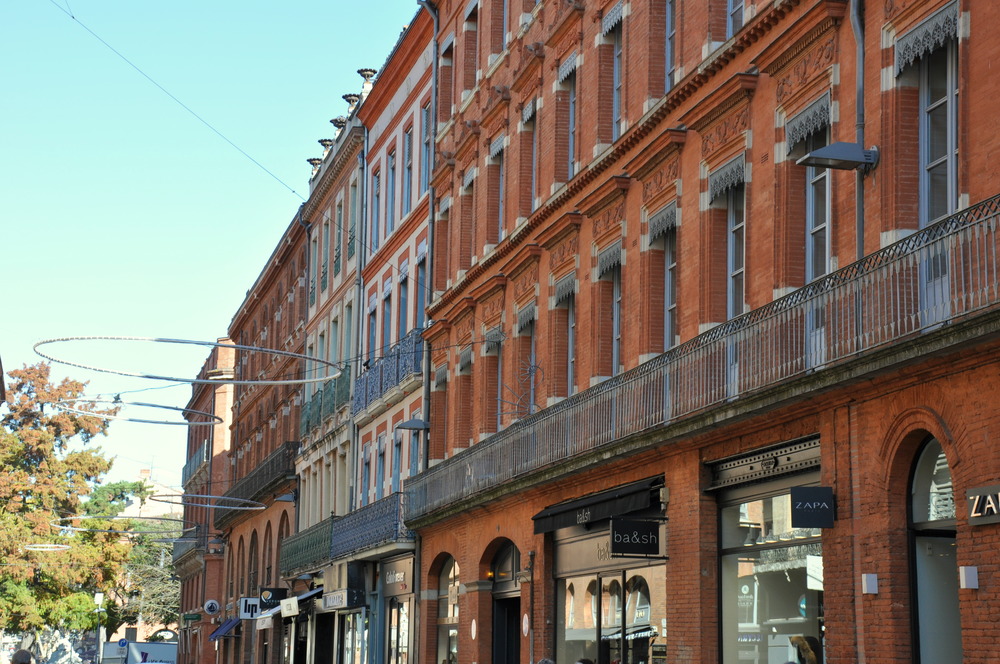
Connecting Place Saint Georges to Place Wilson, Rue Saint Antoine du T is one of the prettiest streets in Toulouse. It is lined with tall buildings with majestic facades. The street’s curious name actually comes from the former monastery of Saint-Antoine that stood there in the Middle Ages, whose monks wore a T-shaped cross on their habits… Today, the street is home to many fashion boutiques and beautiful apartments.
VISIT TOULOUSE : 6. ITS MUSEUMS
Musée des Augustins
The museum houses a beautiful collection of sculptures and paintings in a sumptuous setting. The rooms are arranged around an old cloister where a convent garden has been reconstructed. There is also a church next to the cloister, which you can visit. The Musée des Augustins has an important collection of sculptures from the Romanesque period to the 19th century, as well as masterpieces of painting from the 14th to the 19th century. The rooms on the upper floor house beautiful paintings by Delacroix, Ingres, and Vigée le Brun.
Don’t miss the Romanesque sculpture room, where the pieces are beautifully displayed alongside contemporary art. Other temporary contemporary works are also exhibited in the museum throughout the year.
Practical information –Musée des Augustins: Esquirol metro station – admission: €9 (reduced rate: €5, free for students for the permanent collections). Opening hours: 10 a.m. to 6 p.m., closed on Tuesdays.


Fondation Bemberg
Less well known than the famous Musée des Augustins, it is also incredibly rich. The foundation is located in the Hôtel d’Assézat, one of the most beautiful mansions in Toulouse. Don’t hesitate to enter the courtyard even if you don’t want to visit the museum. This magnificent mansion was built in 1555 for Pierre d’Assézat, a wealthy merchant who made his fortune in Toulouse’s “blue gold”: pastel. A color halfway between lavender and sky blue, it is extracted from the leaves of a plant grown around Toulouse. Today, pastel is still used for the dermatological properties of its oil.

The Bemberg Foundation’s collections span from the 15th to the early 20th century. The oldest works are displayed in rooms decorated like a rich apartment, with period tapestries and furniture. Each room has a theme: one room is dedicated to Venice, another to bookbinding, and another to a portrait gallery.
It is truly the setting and the diversity of the works that give charm to this incredibly rich museum. Great names from every era are on display: Cranach, Vigée le Brun, Monet, Renoir, Picasso…
Practical information: Bemberg Foundation: admission €8 (reduced rate: €5). Opening hours: 10:00 a.m. to 12:30 p.m. and 1:30 p.m. to 6:00 p.m., late opening on Thursdays, closed on Mondays. http://www.fondation-bemberg.fr
Good to know: On the first Sunday of every month, the city’s museums are free for everyone.

Musée des Abattoirs
A modern and contemporary art center with a somewhat sinister name, this is one of the city’s most beautiful exhibition venues. It is located on the left bank of the Garonne. The interior is very beautiful, with a large brick hall enhanced by arcades that can accommodate monumental works. The museum houses collections of great modern artists, as well as contemporary works and creative spaces.
Outside, you can also stroll through the adjoining Raymond IV garden, which offers a beautiful view of the Garonne. You will also have access to the Viguerie footbridge, which runs along the left bank of the river between the Pont des Catalans and the beautiful Pont Saint Pierre.
Practical information: Musée des Abattoirs: admission €7 (reduced rate: €4). Opening hours: 12pm-6pm, late opening on Thursdays, closed on Mondays and Tuesdays. http://www.lesabattoirs.org/
Good to know: On the first Sunday of every month, the city’s museums are free for everyone.


VISIT TOULOUSE : 7. THE JAPANESE GARDEN
In the middle of the Compans Caffarelli public garden is a charming Japanese garden, which offers a little peace and exoticism amid the hustle and bustle of the city. Surrounded by a traditional wall, it features a tea pavilion, a small red bridge, a pond with carp, and a beautiful collection of plants. The setting is perfect and invites you to escape from it all.
Free admission


VISIT TOULOUSE : 8. TOULOUSE’S CANALS
Right next to the Japanese garden, the famous Canal du Midi is a favorite spot for Toulouse sports enthusiasts. A stroll along the water’s edge is pleasant, but I recommend renting a bike so you can go further and escape the city. You’ll quickly reach quiet areas with beautiful scenery. The canal is also a UNESCO World Heritage Site!
At 241 kilometers long, the Canal du Midi connects Toulouse to the Mediterranean. It is one of the oldest canals in Europe still in operation (it was built under Louis XIV). With a little time and motivation, you can reach the magnificent city of Carcassonne and even Béziers!

The Canal de Brienne is much shorter and less well known than its counterpart. It is also more secluded and offers a pleasant walk between Place Saint Pierre and the port of Embouchure. You can also reach the banks of the Garonne, which are one of Toulouse’s “five must-see” attractions.

OTHER GEMS TO DISCOVER NEAR TOULOUSE
Discover other gems in Haute-Garonne that are not to be missed in my article 6 beautiful discoveries to make around Toulouse and also discover the mountain side of Haute-Garonne!
La Cité de l’Espace (15 minutes away): a must-see spot in the Toulouse region that will delight young and old alike with its exploration of space, from astronomy to astronautics.
Montauban and the Tarn-et-Garonne (50 minutes away): another magnificent pink city, capital of a department to be discovered along the river over a few days…
Albi and the Tarn (55 minutes away): discover this magnificent department through Albi, the superb pink city, but also its charming little villages and superb natural areas…
Getaway in the north of the Gers (1.5 hours away): between heritage and gastronomy, the hills of the Gers have a lot to offer! An ideal area for a 2-3 day road trip.
If you also use Pinterest, follow me on this network: La Marinière en Voyage – and don’t forget to pin this article so you can find it easily!
