
Do you want to visit Bayonne, France? Here is my guide to prepare your trip and enjoy a preview!
This is my first of the 3 posts on the Basque Country. It’s easy to fall in love with its quaint villages, magnificent coastline, and unique, gourmet cuisine. After Bayonne, I’ll take you to Visit St Jean de Luz, and the 5 Most Beautiful Villages in Basque Country
Let’s start with a one-day visit to Bayonne, a historic city located at the confluence of the Adour and Nive rivers. Bayonne proudly proclaims its Basque identity, and this can be felt in the charming streets of Grand Bayonne and Petit Bayonne. Signs in two languages, posters and bookshops in Basque, trinquets (Basque pelota courts)… The regional culture permeates the city, and this is what gives it its unique personality! So if you’re wondering how to visit Bayonne in one day, follow the guide!
Quick highlights you’ll find in this guide about visiting Bayonne, France:
- Visit Bayonne France: Petit Bayonne, Grand Bayonne, Sainte Marie Cathedral, banks of the Nive, and Basque streets
- Practical tips: how to get there, where to stay, and how to organize your time for a one-day visit
- Highlights of the city: Basque culture, trinquets, bilingual signs, and historic streets
- Gourmet experiences: chocolate, cured meats, and market halls
- Other activities around Bayonne for a complete Basque Country adventure
VISIT BAYONNE – PRACTICAL TIPS
How to get there ?
Bayonne is located two hours south of Bordeaux and 45 minutes north of the Spanish border. By train, it takes 3 hours and 50 minutes from Paris and 2 hours from Bordeaux.
Biarritz-Anglet-Bayonne airport is 15 minutes from Bayonne. Airlines such as Easyjet, Ryanair, and Hop! fly to Bayonne from major French and European cities at reasonable prices.
It’s very easy to visit Bayonne in one day on foot. Rent a car here if you need to in order to get around Bayonne.
Where to stay to visit Bayonne ?
Here are several suggestions for accommodation in Bayonne!
3 recommended accommodations to visit Bayonne

CITY BREAK MIRADOUR
- In the city center
- Large rooms
- From €120

HÔTEL VILLA LA RENAISSANCE
- Quiet, close to the center
- Beautiful setting
- From €200

CHAMBRE D’HÔTES ETCHEBRI
- In Anglet, close to the sea
- With a pool
- From €150
VISIT BAYONNE : “PETIT BAYONNE”
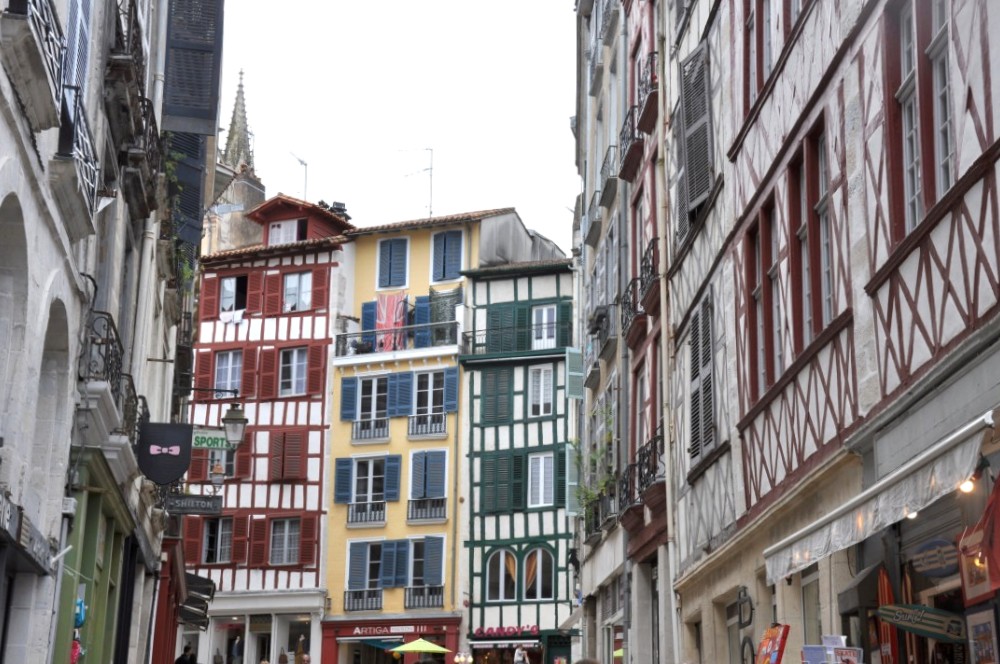
To the east of the Nive River lies “Petit Bayonne,” a lively neighborhood that embodies the soul of Bayonne. Its narrow streets are lined with tall old buildings that are somewhat reminiscent of Old Nice, but with a Basque twist, of course! The wrought-iron balconies are complemented by red or light blue shutters.
I loved this lively neighborhood with its old-fashioned charm and old buildings that could sometimes use a bit of renovation. Here, people go out with friends, play Basque pelota, dance, and live life to the fullest!
Everywhere in the windows, you’ll see the demands of the people of Bayonne, whether for the independence of the Basque country, the welcoming of refugees, or climate change. In Bayonne, people get involved!


Trinquet Saint André
To discover the local culture, I invite you to step inside the Trinquet Saint-André! It’s a former Jeu de Paume hall that has been converted into a Basque pelota court.
There are several variations of this regional specialty depending on the “racket” used. But real Basque pelota is played with bare hands! Incredible, isn’t it? There are sometimes amateur matches, which allow you to discover this unique sport from a small box at the back of the court. You can feel all the locals’ enthusiasm for this sport, it’s really special… A great atmosphere is guaranteed!

The banks of the Nive
The Nive separates Grand Bayonne from Petit Bayonne before flowing into the Adour. It’s one of my favorite places in the city because its banks reflect all the charm of Bayonne! The tall, narrow houses are built close together, as if to prevent them from falling over. While red, blue, or dark green shutters are de rigueur, some facades are even decorated with half-timbering that forms a regular grid pattern. Just opposite, the superb Quai Jaureguiberry is the prettiest quay in Bayonne. Strolling along the banks of the Nive is really pleasant, and the many bars are the perfect place to stop for a drink before exploring the Grand Bayonne, located just opposite.


VISIT BAYONNE : “GRAND BAYONNE”
Grand Bayonne is connected to its cousin, Petit Bayonne, by four successive bridges crossing the Nive River. Grand Bayonne is the historic center of the city, with its colorful streets, cathedral, and pretty market halls.
Crossing the Pannecau bridge, you will come directly to the very pretty Moulis house. Dating from the 16th century, it is one of the most beautiful half-timbered houses in the region. Just opposite, the city’s market halls host the Bayonne market every day.
The streets of Grand Bayonne form the commercial heart of the city. The pretty houses are often occupied by small shops on the ground floor. The streets are warm and lively, and while the houses remain white, the shutters add a splash of color to the city center!


Sainte Marie Cathedral
At the end of Rue Port de Bertaco, you will come to Place Pasteur, where Bayonne Cathedral is located.
And no visit to Bayonne would be complete without stepping inside the most beautiful monument in the city center. The upper part of the exterior is almost ochre, a rather surprising color amid the old white facades of the houses. The interior of the cathedral is also unusual. Its recently renovated apse is full of colors that contrast with the sobriety of the nave. But here, it’s the details that make the difference, with everything finely sculpted.
Near the cathedral’s entrance, on the right-hand side, you can visit the adjoining cloister. It’s a real architectural gem! It also offers a superb view of the cathedral’s exterior.
A few steps from the cathedral, you’ll also see the Château-Vieux, a medieval fortress that has been somewhat clumsily renovated.


VISIT BAYONNE ON A GOURMET TOUR
Visiting Bayonne in one day inevitably involves sampling the local specialities… I must say that I was surprised by the diversity of Basque specialities on offer in Bayonne. As the capital of chocolate (only the locals know that, I think!), ham, and Basque cake, you are sure to enjoy yourself in Bayonne!
Tour and tasting of cured meats at Pierre Ibaïalde
This is a must-do if you come to visit Bayonne! I suggest starting your gastronomic tour with my favorite part of the day, a visit to the Pierre Ibaïalde charcuterie. The tour lasts about 45 minutes. This family-run business (with only five employees) produces the famous Bayonne ham, as well as sausages and foie gras with Espelette pepper.
The tour is fascinating because it explains the ham-making process through the different stages of production. The whole team really conveys their love for the product and their craft!
The hams (from Béarn or Landes) are first salted with rock salt from the region, then seasoned with pepper and chili. They are then dried for 11 months at gradually increasing temperatures. Finally, once they have been deboned by hand, they are pressed to be “reclosed.”
This tradition of Bayonne ham dates back to the 14th century. It was actually made in the countryside and then sold in Bayonne by merchants who traveled along the rivers. King Henry IV (who was from Béarn) made it famous in the 16th century. By promoting the ham from his native southwest, he helped to spread its popularity!
The tour ends with a delicious tasting of several products. The ceiling of the visitor room is covered with drying hams that give off an incredible aroma! I could have stayed there for hours just for the smell… So if you like this type of product, you’re in for a treat!


Around the market halls
Still on the savory side, Basque cheese comes in several varieties that are not to be missed, but the undisputed star remains Ossau Iraty! Cross the bridge over the Nive River and head towards the market halls. You will find small, high-quality cheese makers at the market.
If you get the chance, I’d even recommend going straight to the farms, located on the “cheese route” between Saint Jean de Luz and Gourette. It’s a treat that’s nothing like the cheese you can buy in the supermarket! One thing remains the same, however: the goat’s head stamp with an F in the center is affixed to all farm-produced cheeses in the region, without exception. If it’s not there, it’s dairy production, which has less flavor.
Right next to the market halls, at Lionel Raux, you can try another specialty, Basque cake! This pastry originates from the small village of Sare, which we will discover in a future article… Basque cake is made from a special dough that has a very light almond flavor. It can be filled with cherries or pastry cream. It’s delicious!

Bayonne, French capital of chocolate
Bayonne is also the French capital of chocolate, as it was the first French city to produce it, at the end of the 15th century! Jews expelled from Spain and Portugal brought this new product, discovered in Latin America by the conquistadors, with them. Today, you can find it in different forms and with various flavors. But my favorite is still dark chocolate with Espelette pepper, because the two flavors go together perfectly!
To taste these products, I recommend the lovely Daranatz chocolate shop, located under the arcades of Rue Port-Neuf. You can find more information in the “Practical tips – what to bring back from Bayonne” section.
If you want to discover the world of chocolate from the bean and make your own chocolate bar, don’t hesitate to book a workshop with a craftsman! Indulgence and pleasure guaranteed!
Book your workshop to make your own chocolate!
Finally, you can discover other Basque specialties at restaurants, such as poulet basquaise (Basque-style chicken) or mamia, a small pot of sheep’s milk curd served with honey. The Chistera restaurant offers typical, high-quality cuisine at very reasonable prices. – 42 rue Port-Neuf
What to bring back from Bayonne?
As you’ll see, Bayonne is renowned for its gastronomy, so you’ll be spoiled for choice!
Here are a few good addresses mentioned below in the “Basque gastronomy” section to tantalize your taste buds…
Bayonne ham, sausages and foie gras with Espelette pepper, axoa de veau (Basque specialty) with Espelette pepper purée… – L’atelier Pierre Ibaïalde, 41 rue des Cordeliers – tours (45 min) several times a day, reservations required on the website – €5/person.
Basque cakes with cherry or cream (individual cakes or to share) – Lionel Raux, 7 rue Bernadou.
Chocolaterie Daranatz – 15 Arceaux du Port-neuf.
Espelette pepper also comes in all shapes and sizes and is sold in Bayonne, but we’ll tell you more about that during our visit to the village of Espelette!
But Basque specialties aren’t limited to food! You can also discover the maison de l’Espadrille, because this famous summer shoe originated in the region – Maison de l’espadrille, 2 rue Lormand.
Finally, Basque linen is a thick fabric with seven stripes that is used to make decorative items, linens, and accessories. You’ll find it everywhere in Greater Bayonne!

VISIT BAYONNE: EXPLORE THE SURROUNDING AREA
Biarritz (15 minutes away): Bayonne’s cousin and rival, Biarritz is a radically different city. Its chic seaside atmosphere is also worth a visit. Its beaches are a paradise for water sports enthusiasts!
La Bastide Clairence (25 minutes away): This typical Basque village is classified as one of the “most beautiful villages in France.” It is the closest to Bayonne and I will tell you more about it in an article dedicated to the 5 Most Beautiful Villages in Basque Country
Saint Jean de Luz (30 minutes away): I fell in love with this small seaside town, which perfectly blends Basque traditions and a seaside resort atmosphere. To visit it, check out my article to Visit St Jean de Luz, France
Espelette (30 minutes away): This village gave its name to the red chili pepper that can be seen drying on its facades and is definitely worth a visit. Its narrow streets are full of charm and, above all, you can discover the history and culture of the Espelette chili pepper! For me, it is one of the 5 Most Beautiful Villages in Basque Country.
Dax and the Landes (45 minutes away): The Landes region is also full of gems, from its famous beaches to its lesser-known but equally beautiful hinterland! Read my article Visiting the Landes off the beaten track to find out more!
If you also use Pinterest, follow me on this network: La Marinière en Voyage – and don’t forget to pin this article so you can find it easily!
