
Visiting the Calanques de Piana in Corsica was one of my dreams on the Isle of Beauty, along with the wonderful hilltop town of Bonifacio. Located two hours north of Ajaccio, they are part of southern Corsica, although geographically closer to the north.
Their red cliffs are listed as a UNESCO World Heritage Site and are famous for the perfect heart carved into a rock face. At the foot of the calanques lies another natural wonder: the Scandola Nature Reserve.
There are many ways to visit the Calanques de Piana: by car, by boat, on foot… Let me take you on a tour of the different options, hoping to inspire you if you are planning to visit Corsica soon! Are you ready to be amazed? Let’s go!
Quick highlights you’ll find in this guide about a Calanques de Piana tour:
- Calanques de Piana tour: explore the red cliffs, Scandola Nature Reserve, and nearby villages of Piana and Porto
- Practical tips: how to get there, where to stay, and how to organize your time
- Ways to visit: by car, by boat, and on foot for the best experience
- Highlights of the region: Capo Rosso hike and stunning viewpoints
- Other things to do around Calanques de Piana for a complete Corsica adventure
What do do after visiting Calanques de Piana?
The Perfect Itinerary to Visit Corsica : Best Places and Tips
PRACTICAL TIPS FOR YOUR CALANQUES DE PIANA TOUR ITINERARY
How to get to the Calanques de Piana?
Porto is located 1 hour and 45 minutes north of Ajaccio, and the calanques are 15 minutes from Porto (1 hour and 30 minutes from Ajaccio) by car. From Ajaccio, there are many flights and ferry connections from the mainland.
Where to stay to visit the Calanques de Piana?
Whether you want to stay in the village of Piana, with views of the calanques and the sea, or near Porto Ota (with more affordable prices), here are my favorite suggestions:
3 recommended places to stay when visiting the calanques de Piana

HÔTEL SCANDOLA
- In Piana
- Breathtaking sea view
- From 130€

HÔTEL CAPO ROSSO
- In Piana, panoramic view
- With a pool
- From 160€

HÔTEL LE BELVÉDÈRE
- Well located in Porto Ota
- Good value for money
- From 70€
How to organize your time
Allow two days to visit the Calanques de Piana, the Scandola Nature Reserve (half a day by boat), the village of Piana, and the surrounding beaches. The hike takes half a day.
If you’re just passing through the region (which is a shame!), don’t miss the D81 road at sunset.

What to bring back from the Corsica?
It’s hard to choose as there are so many delicious things to taste in Corsica! Corsican charcuterie is a must-have souvenir (coppa, figatellu, etc.), as are sheep’s milk tomme and pain des morts, a bread made in early November.
For something sweet, try gelée d’arbouse (strawberry tree jelly), canistrelli and Corsican honey, with a dash of myrtle to top it all off!
CALANQUES DE PIANA TOUR – BY CAR
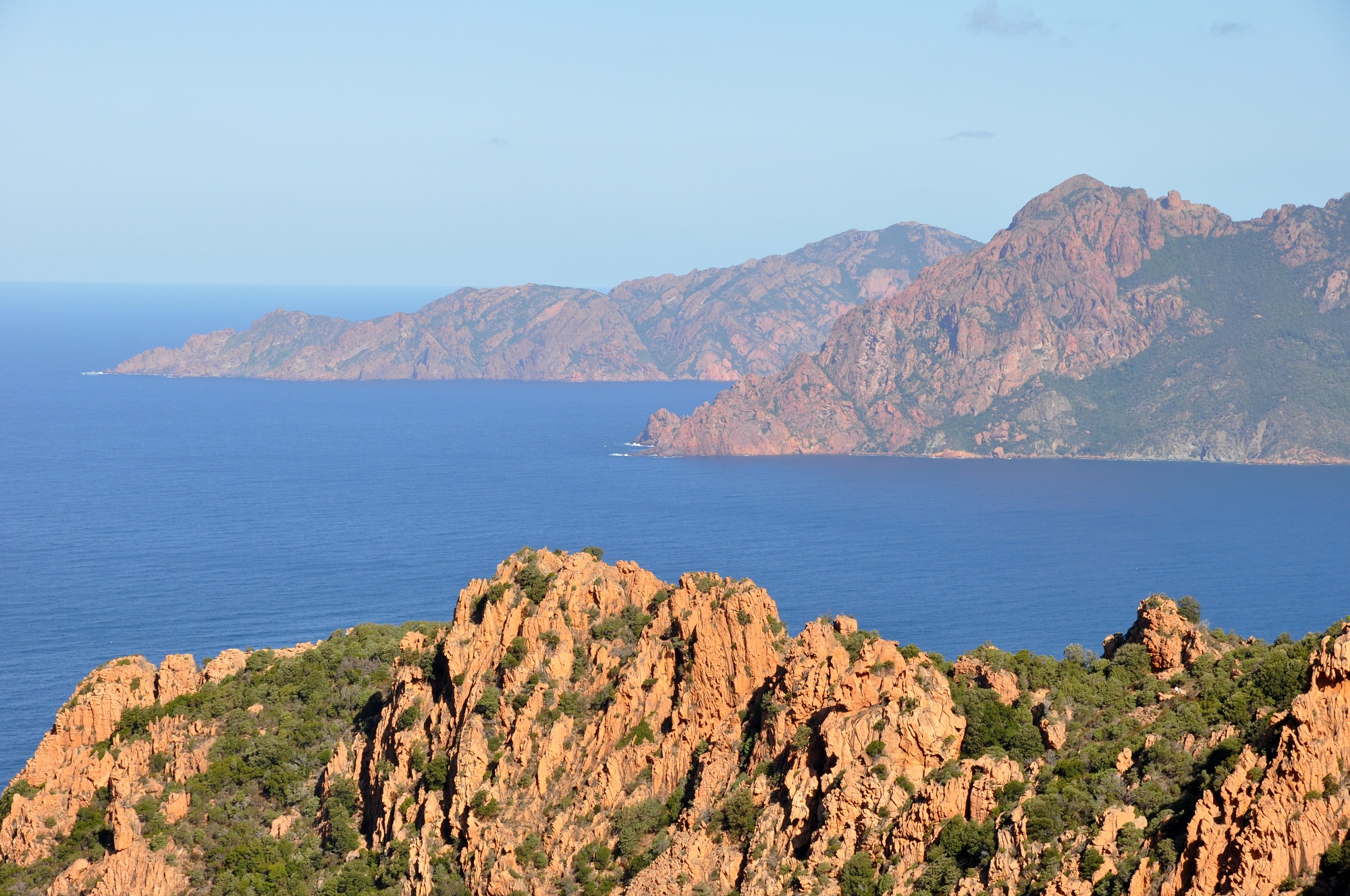
The sumptuous calanques of Piana are usually first discovered by road. The D81 departmental road linking the small village of Piana to the town of Porto is a route full of wonders. It is where flamboyant porphyry meets the azure blue of the Mediterranean… The road winds its way through jagged ridges and steep canyons, in which you can make out amazing shapes.
If you look closely, you can see a turtle, a bishop, a bride, a dog, and other figures. And of course, the famous heart of the Calanques de Piana, known throughout the world. It is the very first shape you will see on your left as you come from Piana. You can’t miss it!

According to legend, the calanques were torn apart by Satan himself, a disappointed lover who wanted to take revenge by making the place uninhabitable! French writer Guy de Maupassant describes these cliffs, tormented by the forces of nature, very well:
“They were peaks, columns, pinnacles, surprising figures shaped by time, the gnawing wind and the sea mist. Up to three hundred meters high, thin, round, twisted, hooked, misshapen, unexpected, fantastic, these surprising rocks looked like trees, plants, animals, monuments, men, monks in robes, horned devils, oversized birds, a whole monstrous people, a menagerie of nightmares petrified by the will of some extravagant god.”
At sunset, the calanques light up and create a spectacle that will stay with you for a long time…

Practical tips for visiting the Calanques de Piana by car
I recommend taking the Calanques road at least twice. Once shortly before sunset, and again in the morning light. You’ll never tire of driving along this road, and the colors really change throughout the day. But if you can’t make a round trip, be sure to see the sunset, when the cliffs literally light up. It’s a moment of pure magic that’s not to be missed!
The road is about 9 kilometers long (including 4 superb kilometers). Allow at least 30 minutes to drive it, much more in high season. Be careful, however, as the departmental road is very narrow and winding, and traffic is therefore difficult. This is particularly true because buses and trucks are not completely prohibited, so be careful when driving. It is possible to stop at a few places on the side of the road, but only in low season. However, it is worth getting out of the car for a few moments to admire the breathtaking scenery.
Cliff circuit (D81): a map is available at the Porto/Piana tourist office showing the location of the different shapes to be seen in the cliffs.


CALANQUES DE PIANA TOUR: THE VILLAGES
Piana
At the entrance to the Calanques is the village of Piana, listed as one of the most beautiful villages in France. However, it owes this title to its extraordinary setting rather than the village itself, although it is not unpleasant to stroll around.
Through its narrow streets, you will discover some pretty houses built from local stone, as orange as the calanques! Piana also has small white houses that contrast with the color of the sea surrounding them.
The view of the village and the calanques in the background is definitely worth the detour. To see it, go to the entrance of Piana when you arrive from Ajaccio.


Porto
Nestled in a steep valley, Porto is the departure point for boats heading to the calanques and the Scandola nature reserve. The town has no attractions apart from its pretty Genoese tower, which offers a breathtaking view of the Gulf of Porto, but it is ideally located for exploring the calanques of Piana.


CALANQUES DE PIANA TOUR, BY BOAT
The boat is the only way to discover the highly protected Scandola Nature Reserve. It is forbidden to access it by land, to dock there or to dive there. Only a very small part is accessible to tourist boats, which, due to their number, inevitably affect the fabulous ecosystem for which it is known. Its flora and fauna, both terrestrial and underwater, make it one of the most beautiful reserves in the world!
The boat trip allows you to discover some extraordinary landscapes: the red rock massifs are dotted with holes, vegetation, basalt columns, and volcanic formations of various colors. The rocks sometimes give the impression that a crazy painter has been there and wildly thrown pots of paint on the cliffs! On the sea side, the water is a magical transparent turquoise and flanked by rocky islets where the reserve’s many birds come to take refuge.


The walk also allows you to stop at Girolata, a small fishing village isolated from the rest of the world. Although the setting is wonderful, the village is no longer very authentic, as the few year-round residents are invaded daily by thousands of tourists arriving by boat. But its charm also lies in its remote location: it takes 30 minutes by boat or 2 hours of hiking to get there…


You can then extend your trip to the Calanques de Piana. The cliffs seen from the road are just as impressive from the sea. Some small boats even manage to squeeze into the pretty starry caves (you’ll see why…) where the red walls contrast with the turquoise water. When you discover some of the coves, you can imagine that paradise really does exist on earth…
Practical tips for visiting the Calanques de Piana by boat:
Several companies offer this trip in the Scandola Nature Reserve (of varying lengths depending on whether or not it includes the Calanques de Piana) for roughly the same price. The main differences are in the type of boat (opt for semi-rigid or electric boats for a better experience). And remember to book, especially in high season!

THE MOST BEAUTIFUL HIKE IN THE CALANQUES DE PIANA: CAPO ROSSO
he last option for visiting the Calanques of Piana is hiking. There are several trails to choose from, but this time I’ll take you on a superb walk along the coast,to the Capo Rosso. This is the westernmost point of Corsica! The walk takes about 3 hours, with only one difficult section (a steep climb) at the very end of the trail. It is accessible to everyone, but remember to bring hiking shoes and water as there is no shade at all.
I loved this hike, which offers magnificent views along the entire route. Right from the start, the Genoese tower of Turghiu, which dominates Capo Rosso (“red cape”), is in sight. It is one of the many Genoese watchtowers on the Corsican coastline, overlooking the Mediterranean from a height of 330 meters since 1608! This will also be the highlight of your hike!


The path winds along the slopes of Capo Rosso between esplanades of low vegetation, sometimes dotted with old sheepfolds. The colors contrast between the red cape (which lives up to its name) and the deep blue of the sea. Below, the jagged creeks jutting out into the sea offer glimpses of turquoise coves that are unfortunately inaccessible…
The view from the top is only revealed at the very end! But it is undoubtedly even more beautiful because it is unexpected after a few dozen minutes of steep climbing. To the north lies the sumptuous Gulf of Porto and its calanques, and to the south, the Gulf of Sagone. You can even climb to the top of the tower via a staircase worthy of a haunted castle.
Once you’ve finished your hike, don’t hesitate to continue a little further along the road to relax on the beautiful Arone beach.
Practical tips for visiting the Calanques de Piana on foot – Hike to Capo Rosso: start from the Capo Rosso car park on the D824 coming from Piana. Approximately 3 hours (500m elevation gain) – see detailed route


If you are visiting the Calanques of Piana during a trip to Southern Corsica, I invite you to check out my post Best Places to Visit in Corsica – the Perfect Itinerary! You will find all the must-see attractions and my tips for organizing your stay!
What do do after visiting Calanques de Piana?
The Perfect Itinerary to Visit Corsica : Best Places and Tips
WHAT TO DO AROUND CALANQUES DE PIANA ?
Cargèse (25 minutes from Piana): an ancient Greek colony, this town has a pleasant, peaceful atmosphere. The white walls of its houses almost give the impression of being in Greece. Right next door, the beaches of Cargèse and Sagone are ideal for enjoying the turquoise waters of the Mediterranean.
Ajaccio and Southern Corsica (1 hour from Piana): check out my post Best Places to Visit in Corsica – the Perfect Itinerary!
Calvi (1 hour and 45 minutes from Piana): the jewel of Upper Corsica, Calvi invites you to explore its rich history, stunning beaches, and charming, authentic countryside! Click here to visit Calvi through 8 must-see sights and activities.
Coming soon on La Marinière en Voyage…
Discovering Antibes, Arles, the Pink Granite Coast, and the end of La Marinière’s adventures in Southern Corsica… So to make sure you don’t miss a thing, subscribe to the newsletter!
If you also use Pinterest, follow me on this network: La Marinière en Voyage – and don’t forget to pin this article so you can find it easily!
